
Digitalising Shift Handover:
Enhancing Efficiency in Fast-Paced Manufacturing
The project was a collaboration with openpack — a successful German start up who is helping their clients in packaging industry with digitalisation, networking of industrial machines (Industry 4.0 or IIoT), in standardising data formats and optimising industry processes such as purchase, sales, etc.

The Problem
Many Openpack clients in the packaging industry struggled with inefficient, paper-based shift handovers due to the lack of a defined process, leading to delays, reduced efficiency, and information loss.
Goal
The goal was to create a flexible and user-friendly shift handover interface that would integrate seamlessly with the Openpack platform. The aim was to offer a scalable and efficient solution that could meet the diverse needs of clients.
Phase 01 : Factory - Onsite Visit
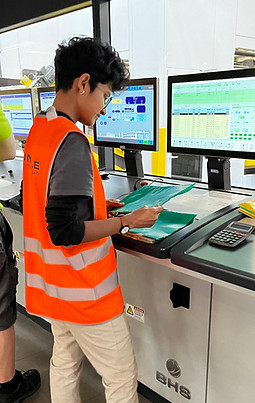
To develop a profound and thorough understanding of the challenges faced on the factory floor, we conducted an in-depth on-site visit to understand factory-floor challenges, engaging with workers, shadowing routines, and observing operations firsthand to identify inefficiencies and gain insights into daily workflows.
This hands-on approach enabled us to extract vital insights, including:
-
Floor environment
-
Method of working
-
Hierarchy, Roles and Information flow
-
Communication practices
-
Documentation methods
-
Production pipeline and process


Phase 02 : Desk Research
Building on our understanding from the on-site visit, we turned to desk research to explore how shift handovers are managed in various industries. By analyzing industry standards, best practices, and existing digital solutions, we identified approaches that could inform our design.
We reviewed academic studies and industry reports, uncovering valuable insights that guided us in crafting a customized digital shift handover solution specifically tailored for the packaging industry. This step also highlighted essential features and tools to enhance the efficiency and practicality of the solution.


In a study :
All three support modalities—face-to-face, video, and audio recordings, reduced task errors significantly over written communication alone. The support modality most preferred by participants was face-to-face communication; the least preferred was written communication alone.
Phase 03 : Interviews
After studying the operational landscape and industry practices, we conducted in-depth interviews with Shift Handover Managers at the packaging plants. These interviews allowed us to further explore specific requirements and pain points.
Key characteristics of the interviews included:
-
Semi-Structured Format : To ensure flexibility while maintaining focus.
-
Category-Based Questions: Covering various aspects of the shift handover process.
-
Language Options : Conducted in English or German, based on the participant’s preference.
We developed an initial set of questions organized by topics, which were later refined for clarity and precision.
Phase 04 : Analysis
The insights derived from our interviews painted a comprehensive picture of the current operational practices and bottlenecks in the handover process. Key observations include:
-
Key Topics Addressed: Discussions during handovers typically revolve around special orders, job allocations, employee absences, maintenance issues, accidents, and other critical matters.
-
Duration Challenges: While handovers currently consume 20–25 minutes, stakeholders indicated that reducing this to a streamlined 10–15 minutes would be more effective.
-
Setting and Communication: These handovers are primarily conducted between shift managers in controlled, quiet environments like offices, with follow-up communication extending to the larger team afterward.
-
Gaps in Information Flow: Important updates often fail to reach the night shift, particularly when sourced from day-only departments such as Production Planning.
-
Absence of Standardized Protocols: Handling of serious incidents and accidents lacks uniform procedures, with records often kept manually in logbooks or as informal notes.
Additionally, we engaged participants in discussions about their pain points and aspirations for an improved system. This in-depth review of the interview transcripts enabled us to pinpoint specific shortcomings in the existing framework and identify promising opportunities for digital enhancements to address these challenges effectively.

Facts :
-
Klingee Factory’s late shifts start at 13:15, with a 20-minute paper-based handover.
-
Changes are recorded on paper, making shift transitions and access difficult.
-
Sick leaves require adjustments to production orders to maintain operations.
-
The factory has no KPI system.
-
Material shortages disrupt production planning and execution.
-
Four product managers, split between morning and night shifts, mainly communicate during handovers.
-
Staff shortages, especially in specialized roles, create operational challenges.
-
Some stakeholders support digitizing processes, anticipating the retirement of experienced managers.
Phase 05 : Design and User Feecback
After gathering insights from our research and interviews, we had a solid base to work from. We started by sketching out wireframes to lay down the basic structure of our solution.


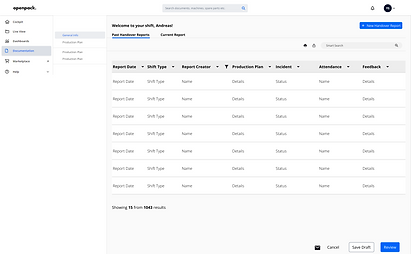

As a next step, we created a low-fidelity click prototype and tested it with real users to gather feedback, which was crucial and helped us make necessary improvements. With those adjustments in mind, we moved on to develop a high-fidelity prototype, fine-tuning it to meet the specific needs and requirements we had identified.
Phase 06 : Hi Fidelity Prototype

Use case: Daily Follow-up calls
Prototypesd a resolution to view the system on a bigger screen, which was actually something they wanted to have for a better team discussion during the daily calls in the central glass box area.
